


Celestron 1.25" Filter and Eyepiece Set
Celestron 1.25" Filter and Eyepiece Set
Free delivery
Standard delivery with advance payment. Express and cash on delivery use the regular rates. The final cost is shown before payment.
Delivery detailsOrder cutoff: 13:00 Warsaw time
How we estimate delivery
An estimate for standard delivery, calculated from payment confirmation. Preparation time, weekends and public holidays are taken into account. The cutoff is 13:00 Warsaw time. Final timing depends on the carrier and delivery address. The countdown ends at 13:00 Warsaw time on the next order-processing day. Payment must be confirmed by then. After the deadline, the estimate moves to the next processing day.
Couldn't load pickup availability
Celestron


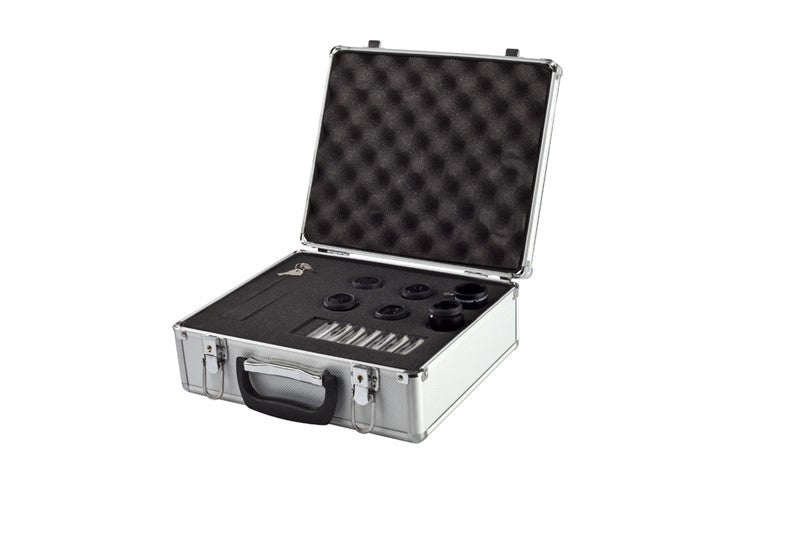
A set of essential Celestron 1.25" filters and eyepieces that expands the telescope's observational capabilities.
Set contents:
● 5 Celestron Plössl eyepieces with a diameter of ø=1.25": 4-element optics with a 52° (52-degree) true field of view — the eyepieces provide a sharp and clear image. All are covered with multi-layer MC anti-reflective coatings to improve image contrast and resolution, eyepiece focal lengths: 6 mm, 8 mm, 13 mm, 17 mm, and 32 mm. Together with the Barlow lens, this provides the equivalent of up to 10 eyepieces.
● 2x Barlow lens complementing the Plössl eyepieces, maximizing the set's versatility in terms of magnification selection. Like the eyepieces, the lens is covered with MC anti-reflective coatings.
● 6 color filters with a diameter of ø=1.25": yellow (#12), orange (#21), red (#25), light green (#56), green (#58A), intermediate blue (#80A), and a gray lunar filter, also with a diameter of ø=1.25" - combining the appropriate eyepiece focal length with a filter can greatly improve the amount of detail visible on the surface of the observed object
● aluminum case, allowing you to transport your set conveniently and safely.
Yellow filter (#12)
The Sky-Watcher yellow #12 color filter is designed for observing Solar System bodies. Designed for mounting in the ø=1.25" standard. The yellow filter reduces blue color, increasing the contrast between dark areas and bright desert regions when observing Mars. When observing the Moon, it improves contrast for telescopes larger than 10”. It can also be useful when observing the planet Venus.
Orange filter (#21)
Recommended uses for this filter: Moon - very useful for improving contrast between surface features in 6" and larger telescopes, with or without a polarizing filter. Mercury - darkens the Earth's sky during daytime observations to reveal subtle, rarely visible albedo differences on the surface. Venus - darkens the Earth's sky during daytime observations to more clearly reveal its phases. Mars - increases the contrast of polar caps, frosted areas, low clouds, and dust storms against ochre-colored desert areas. It also sharpens the edges of yellow dust clouds. Jupiter - reveals the structure of the bands and brings out the belts and details in the sub-polar regions. Saturn - improves the structure of the atmospheric bands and highlights the blue-toned sub-polar regions. Comets - can be placed over filter #38A to improve the contrast of the orange D-lines of sodium in the gaseous tails of comets in 10" and larger telescopes. Improves the resolution of the head and dust tails in 10" and larger telescopes. Solar observations - used when we want to achieve proper color reproduction when using a solar filter made of AstroSolar® mylar film by Baader Planetarium. Filter transmission Tmax=46% (OD=0.3).
Red filter (#25)
The red #25 color filter is designed for observing Solar System bodies. Designed for mounting in the ø=1.25" standard. The red filter strongly reduces blue and green colors, and to some extent, yellow color as well. It can be useful for observing bluish structures in Jupiter's atmosphere. Improves the visibility of the polar caps on Mars. During daytime planetary observations, it clearly darkens the sky's brightness, improving contrast.
Green filter (#58)
The DO-GSO dark green #58 color filter is designed for observing Solar System bodies. Designed for mounting in the ø=1.25" standard. The dark green filter strongly cuts out blue, red, and yellow light. It works well for observing the Moon and very bright comets, where it allows the elements glowing in the green oxygen emission line to become visible.
Intermediate blue filter (#80A)
Recommended uses for this filter: Moon - very useful as a lunar filter that increases contrast against the dark sky background in 6" and larger telescopes. Mercury - can make it easier to observe rarely visible darker surface features viewed at dusk when the planet is low on the horizon. Venus - increases the contrast of occasionally visible darkening in the upper layer of Venusian clouds. Mars - useful for improving the visibility of surface features as well as local dust storms, clouds, and ice grain fog in 8" or larger telescopes, especially during the occurrence of the still unexplained phenomenon known as the so-called purple brightening (when the Martian atmosphere - usually visible in a purple hue only as a bright, uniform disk due to the scattering of shorter wavelengths in the thin atmosphere - becomes transparent to a purple or blue filter, revealing large dark surface features). Jupiter - used mainly to sharpen the boundaries between the reddish bands and the adjacent bright zones in the upper atmosphere. Helps locate the Great Red Spot and the belts in the bands. Saturn - brings out details in the bands, zones, and sub-polar regions of the planet's disk. Comets - allows for the highest image resolution of the gaseous tails of comets in 8" and larger telescopes. Filter transmission Tmax=30% (OD=0.5).
Gray ND 0.6 filter (OD=0.6 T=25%)
Gray filter with optical density OD=0.6. It does not change the color scheme, but reduces the brightness of the observed image. It works perfectly for observing the Sun, planets, and the Moon using large, fast telescopes. It can serve as a normal lunar filter, also reducing the glare around planetary disks, allowing for better observation of details on their surfaces. It can also be helpful in resolving brighter double stars. Filter transmission Tmax=25% (OD=0.6).
Note: the gray and orange filters in this set are also suitable for solar observations, but only after applying an additional Baader Planetarium AstroSolar® film or objective filter with an optical density of no less than OD=5.0. For large-aperture telescopes, the image of the Sun on the full aperture may appear very bright.
Delivery and payment
Delivery options and costs depend on your country and basket. See them before confirming your order. Tracking is provided after dispatch.
Read the detailsReturns and claims
See our policy for withdrawal and claims. If something is faulty, contact us with your order number.
Read the details