

Baader 1.25" Color Filter Set
Baader 1.25" Color Filter Set
Free delivery
Standard delivery with advance payment. Express and cash on delivery use the regular rates. The final cost is shown before payment.
Delivery detailsOrder cutoff: 13:00 Warsaw time
How we estimate delivery
An estimate for standard delivery, calculated from payment confirmation. Preparation time, weekends and public holidays are taken into account. The cutoff is 13:00 Warsaw time. Final timing depends on the carrier and delivery address. The countdown ends at 13:00 Warsaw time on the next order-processing day. Payment must be confirmed by then. After the deadline, the estimate moves to the next processing day.
Couldn't load pickup availability
Baader Planetarium

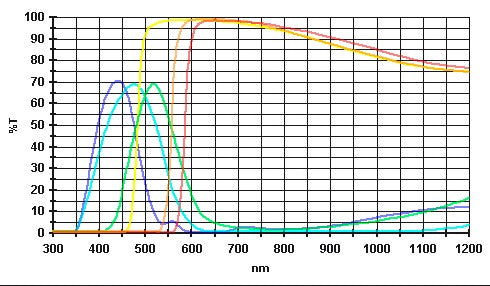
The Baader Planetarium color filter set with a diameter of ø=1.25" provides the highest level of image brightness and also allows for a significant reduction in scattered light within the observing device without sacrificing image sharpness at the high magnifications required for observing delicate details on the disks of planets.
All filter surfaces are mechanically polished to optical quality, meeting flatness and parallelism tolerance requirements at the fractional part of a light wavelength level. This tolerance far exceeds the performance of substrates produced using flame polishing technology, which is used in the production of cheaper filters. Mechanical polishing guarantees perfect parallelism of both surfaces of the substrate with an accuracy of 30″ (arcseconds), which completely eliminates the possibility of a double image effect. In addition, all optical surfaces of the filters are coated with high-quality, seven-layer Phantom Group® anti-reflective coatings, which significantly reduce reflection losses from the filter surface to just 0.25%.
Dark blue filter
The dark blue filter is used for observing the disk of Jupiter. By cutting out red and orange colors, it darkens details such as bands and allows the Great Red Spot to be seen. For these objects, it allows the sharp boundaries between bright zones and bands to stand out. For observations of Mars, this filter is useful for observing the polar caps by darkening the planet's surface and creating high contrast between the surface and the caps. Sometimes dust storms are also visible through this filter. On Saturn, the visibility of delicate details is improved, and the planet's rings are also more contrastingly visible. For Venus, using such a dark filter can improve image quality. It is a filter that offers the best chance for visual observations of delicate structures formed by clouds. For comet observations, the blue filter allows for improved visibility of the ion tail.
Light blue filter
The light blue filter is one of the most frequently used filters. It is by far the best filter for observing Jupiter and Saturn. On Jupiter, the details of the equatorial bands and the Great Red Spot are enhanced. On Saturn, the bands as well as the polar regions are made visible. The filter is very useful for observations of Mars – it allows for the detection of occasional high clouds and also improves the visibility of the polar caps by darkening the planet's surface. It is recommended for observations of Mercury, where it improves the visibility of difficult-to-observe details on the surface of this planet. For Venus, the filter allows for the detection of delicate structures in the cloud cover. An interesting application of the filter can be the observation of double stars with a distinct color difference. The orange, more brightly shining component can be darkened by the blue filter, making it easier to resolve the system into its components. The filter improves the visibility of details on the Moon's disk and also makes the ion tail visible during comet observations.
Green filter
One of the basic filters for observing Mars. Since it has a color opposite to the color of the planet's surface, it creates enormous contrast between the polar caps and the rest of the Martian disk. On the thus contrasted planet, occasional dust storms are also visible. On the planet Venus, there is a chance to see faint structures in the upper cloud cover. The filter cuts out both blue and red colors, which significantly improves the visibility of the bands on the disks of Jupiter and Saturn. On Saturn, brighter details in the bands as well as the polar regions are also illuminated. During Moon observations, a noticeable increase in the sharpness of details is observed.
Yellow filter
This filter is useful for observations of Mars, making the bluish-dark areas of the Martian surface, such as seas and canals, visible. These objects contrast strongly with the bright desert areas. It improves the visibility of the edges of dust clouds during dust storms. On Jupiter and Saturn, it improves the visibility of all bluish details. It works well in observations of the bright zones between the bands and the polar regions. For observations through large telescopes, one can expect improved visibility of details on planets such as Uranus and Neptune. The yellow filter improves the visibility of the dust tail during comet observations and also improves contrast during Moon observations for telescopes with a primary mirror diameter greater than 15 cm.
Orange filter
This filter works excellently for observations of the planet Mars. It darkens areas with a greenish tint, particularly improving the visibility of the boundaries of Martian seas. During observations of Jupiter and Saturn, additional details in the bands of these planets can be observed. The orange filter significantly improves contrast during Moon observations. An interesting use of the orange filter can be daytime observations of planets such as Venus or Mercury – this filter darkens the background sky. For observations with large-diameter telescopes, this filter will be helpful for highlighting structures in the dust tail and the comet's coma. For Sun observations, it is used to achieve proper color reproduction when using a Mylar solar filter.
Note: this type of filter is not suitable for Sun observations without the use of additional film or a Baader Planetarium AstroSolar® lens filter with an optical density of no less than OD=5.0. For large-aperture telescopes, the image of the Sun at full aperture may appear very bright.
Red filter
The red filter strongly blocks green and blue colors. This property is very useful for observations of the planet Jupiter. The bluish structures visible there are clearly darkened and stand out distinctly from the rest of the disk. Useful for observations of polar caps and Martian seas, provided it is used with a telescope with a primary mirror diameter greater than 20 cm. Interesting effects are obtained during observations of the planet Venus. This filter reduces the planet's intense light and also allows certain structures in the cloud cover to become visible. The filter is useful for observations of inner planets in a bright sky – Mercury can be observed earlier and higher above the horizon thanks to the darkening of the background sky, and the same applies to observations of the planet Venus.
- #2458302 Baader Planetarium dark blue filter
- #2458303 Baader Planetarium light blue filter
- #2458304 Baader Planetarium green filter
- #2458301 Baader Planetarium yellow filter
- #2458306 Baader Planetarium orange filter
- #2458307 Baader Planetarium red filter
Delivery and payment
Delivery options and costs depend on your country and basket. See them before confirming your order. Tracking is provided after dispatch.
Read the detailsReturns and claims
See our policy for withdrawal and claims. If something is faulty, contact us with your order number.
Read the details