


Sky-Watcher BKMAK 90 SP Optical Tube
Sky-Watcher BKMAK 90 SP Optical Tube
Free delivery
Standard delivery with advance payment. Express and cash on delivery use the regular rates. The final cost is shown before payment.
Delivery detailsOrder cutoff: 13:00 Warsaw time
How we estimate delivery
An estimate for standard delivery, calculated from payment confirmation. Preparation time, weekends and public holidays are taken into account. The cutoff is 13:00 Warsaw time. Final timing depends on the carrier and delivery address. The countdown ends at 13:00 Warsaw time on the next order-processing day. Payment must be confirmed by then. After the deadline, the estimate moves to the next processing day.
Couldn't load pickup availability
Sky-Watcher


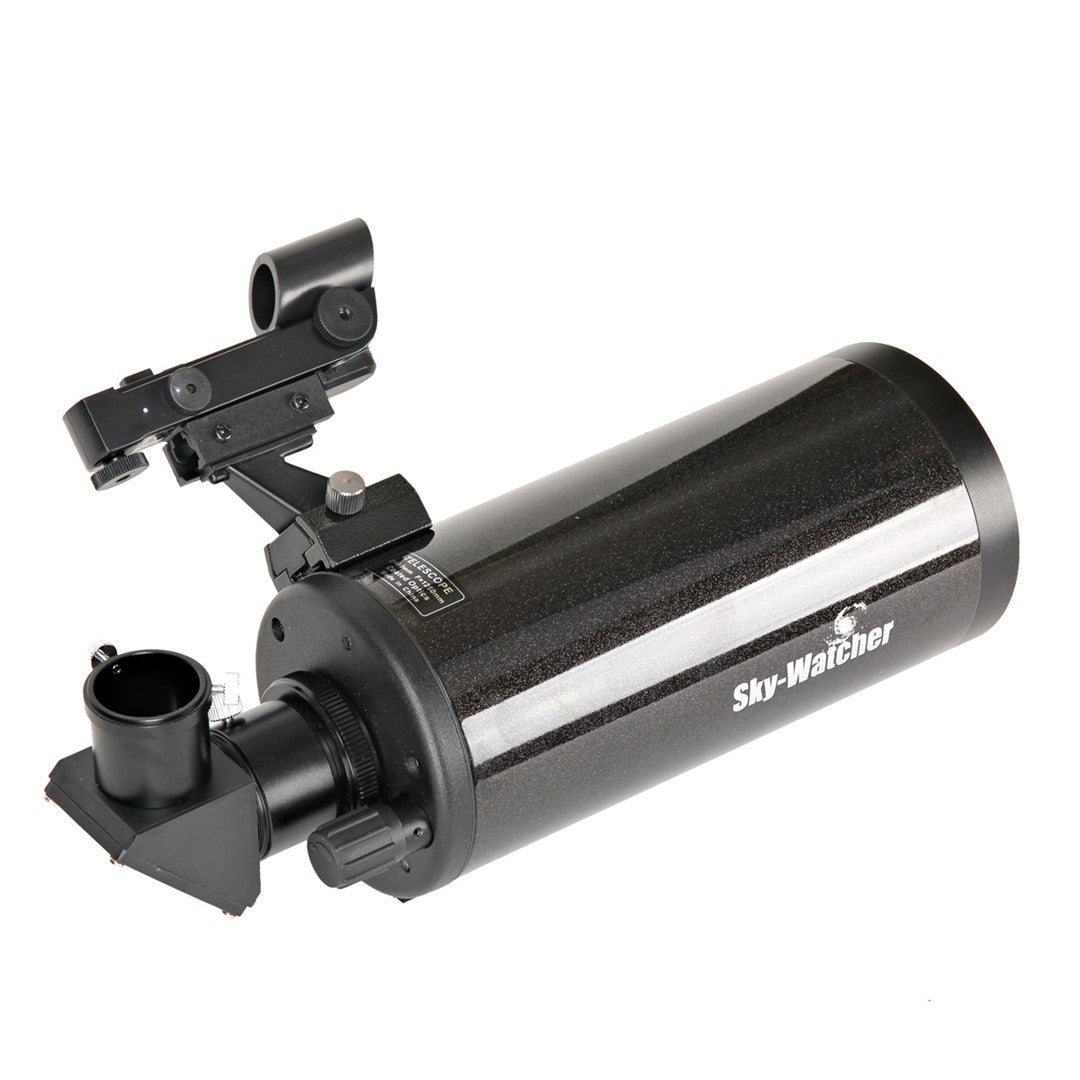
The Maksutov optical system is widely appreciated for its portability, ease of use, and versatility. It is an excellent choice for both terrestrial and astronomical observations. The excellent optics provide an exceptionally sharp image across the entire wide field of view. The telescope consists of a meniscus corrector plate, a primary mirror, and a secondary mirror mounted on the inner surface of the meniscus. These telescopes have reduced coma and exhibit only residual chromatic aberration, providing sharp and vivid images. A major advantage of Maksutov telescopes is their short length, compact design, and generally low weight. Due to their long focal length and small aperture, they are perfectly suited for planetary observation. This design performs well in urban environments, where it is difficult to observe any nebular objects in a bright sky.
Optical system
A telescope consisting of a spherical meniscus corrector (a negative meniscus lens made of crown glass), a primary mirror, and a secondary mirror mounted on the inner surface of the meniscus. Telescopes of this type have reduced coma and astigmatism and generally exhibit only residual chromatic aberration. They provide exceptionally sharp and vivid images. Due to their long focal length and small aperture, they are perfectly suited for observing the Moon and planets. Unfortunately, such a telescope does not allow for large fields of view and is essentially unsuitable for observing nebular objects.
This telescope collects about 180 times more light than the human eye at night, making it possible to observe objects up to almost magnitude 11.4 (with visibility to magnitude 6 by the naked eye). The size of the mirror is also related to the optical resolution, which in this telescope allows for the separation of stars that are more than 1.6” apart.
Mount
Telescope without mount. The tube can be mounted on a photographic tripod – with a suitable connector built into the tube (micromovements recommended).
Eyepiece
The telescope is equipped with a 1.25” eyepiece holder. Focus is adjusted using a knob located near the mirror. It is precisely by adjusting the position of the primary mirror that we adjust the focus. Two eyepieces of this diameter are included in the set.
Astronomical observations
1. Solar System
features on the lunar surface larger than 2-4 km;
sunspots and their structure;
all planets in the Solar System;
phases of Mercury and Venus
Mars’s disk
Jupiter’s equatorial belts and the Galilean moons
Saturn’s rings and the brightest moon, Titan
Uranus and Neptune
the motion of asteroids against the background of stars
observations of bright comets
2. Stars
about 1.3 million stars across the entire sky, with brightness up to about magnitude 11.4
binary and multiple stars separated by more than 1.6”.
the colors of the brightest stars
3. Nebular objects
the brightest objects in the Messier catalog
dozens of globular clusters
hundreds of open clusters
the brightest nebulae
several of the brightest galaxies
Terrestrial observations
The set includes a diagonal mirror that reverses the image left to right. To obtain an upright image, a prism diagonal must be used. With the appropriate diagonal and an alt-azimuth mount or photographic tripod, this telescope can be used for terrestrial observations.
Delivery and payment
Delivery options and costs depend on your country and basket. See them before confirming your order. Tracking is provided after dispatch.
Read the detailsReturns and claims
See our policy for withdrawal and claims. If something is faulty, contact us with your order number.
Read the details