


Sky-Watcher BKMAK 150 OTAW Optical Tube
Sky-Watcher BKMAK 150 OTAW Optical Tube
Free delivery
Standard delivery with advance payment. Express and cash on delivery use the regular rates. The final cost is shown before payment.
Delivery detailsOrder cutoff: 13:00 Warsaw time
How we estimate delivery
An estimate for standard delivery, calculated from payment confirmation. Preparation time, weekends and public holidays are taken into account. The cutoff is 13:00 Warsaw time. Final timing depends on the carrier and delivery address. The countdown ends at 13:00 Warsaw time on the next order-processing day. Payment must be confirmed by then. After the deadline, the estimate moves to the next processing day.
Couldn't load pickup availability
Sky-Watcher


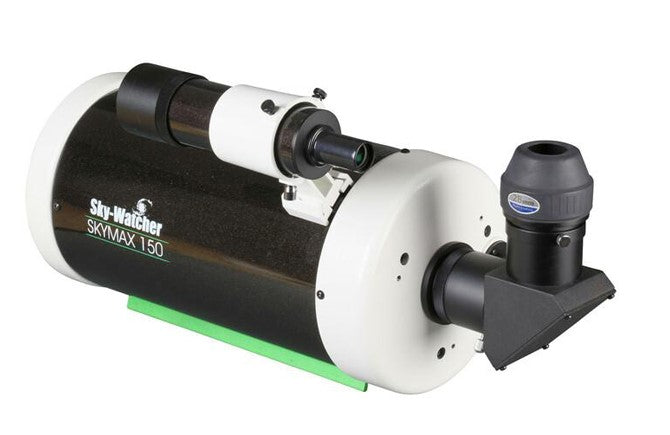
The MAK 150 is an excellent choice for astronomy enthusiasts looking for a compact telescope that offers excellent opportunities for observing the Moon and planets in the Solar System. Maksutov telescopes have reduced coma and exhibit only residual chromatic aberration, providing very sharp and clear images. A major advantage of Maksutov telescopes is their short length, compact design, and generally low weight. Despite its small size, the MAK 150 has a very large focal length of 1800 mm, allowing for the high magnifications needed to study details on the surfaces of planets and the Moon. This model is slightly heavier than the MAK 127, but its larger aperture and focal length offer significantly greater observing capabilities.
This type of design is perfectly suited to urban environments, where it is difficult to observe fainter nebular objects against a bright sky. The telescope comes with a 2-inch eyepiece extension, a 2-inch diagonal, and a 28 mm LE eyepiece providing 64x magnification. The Skymax 150 performs very well when observing deep-sky objects, especially the brightest and most compact ones, such as the Great Orion Nebula, Messier 13, or the Bode’s galaxies, Messier 81 and 82, in Ursa Major.
Optical system
The telescope consists of a spherical meniscus corrector (a negative meniscus lens made of crown glass), a primary mirror, and a secondary mirror mounted on the inner surface of the meniscus. Telescopes of this type have reduced coma and astigmatism and exhibit only residual chromatic aberration. They provide exceptionally sharp and clear images. Due to their long focal length and relatively low light-gathering power, they are perfectly suited for observing the Moon and planets.
This telescope gathers approximately 459 times more light than the human eye at night, making it possible to observe objects down to almost magnitude 13.2 (compared to magnitude 6 visible to the naked eye). The size of the mirror also determines the optical resolution, which in this telescope allows for the separation of stars that are more than 0.77” apart.
Mount
Telescope only. Due to its long focal length, stable astronomical mounts of at least AZ4 (azimuthal) or EQ3-2 (equatorial) class are recommended.
Astronomical observations
1. Solar System
features on the Moon’s surface larger than 1–1.5 km;
sunspots and their structure;
all planets in the Solar System;
phases of Mercury and Venus
the disk of Mars
Jupiter’s equatorial belts and Galilean moons
Saturn’s rings and several of the planet’s smaller moons
Uranus and Neptune
the motion of asteroids against the background of stars
observations of bright comets
2. Stars
approximately 2.4 million stars across the entire sky, down to about magnitude 12.5
binary and multiple stars separated by more than 0.9”.
the colors of the brightest stars
3. Nebular objects
all objects in the Messier catalogue
hundreds of globular clusters, including visible structure
hundreds of open clusters
many nebulae
dozens of galaxies
Terrestrial observations
Telescopes with this type of optics are not particularly well suited for terrestrial observations. A prismatic diagonal must be used to correct the image orientation, making it upright. With a diagonal and a suitable mount, it can be used as a simple instrument for terrestrial observations.
Delivery and payment
Delivery options and costs depend on your country and basket. See them before confirming your order. Tracking is provided after dispatch.
Read the detailsReturns and claims
See our policy for withdrawal and claims. If something is faulty, contact us with your order number.
Read the details