


Sky-Watcher BK 709 EQ1 70/900 Telescope
Sky-Watcher BK 709 EQ1 70/900 Telescope
Free delivery
Standard delivery with advance payment. Express and cash on delivery use the regular rates. The final cost is shown before payment.
Delivery detailsOrder cutoff: 13:00 Warsaw time
How we estimate delivery
An estimate for standard delivery, calculated from payment confirmation. Preparation time, weekends and public holidays are taken into account. The cutoff is 13:00 Warsaw time. Final timing depends on the carrier and delivery address. The countdown ends at 13:00 Warsaw time on the next order-processing day. Payment must be confirmed by then. After the deadline, the estimate moves to the next processing day.
Couldn't load pickup availability
Sky-Watcher


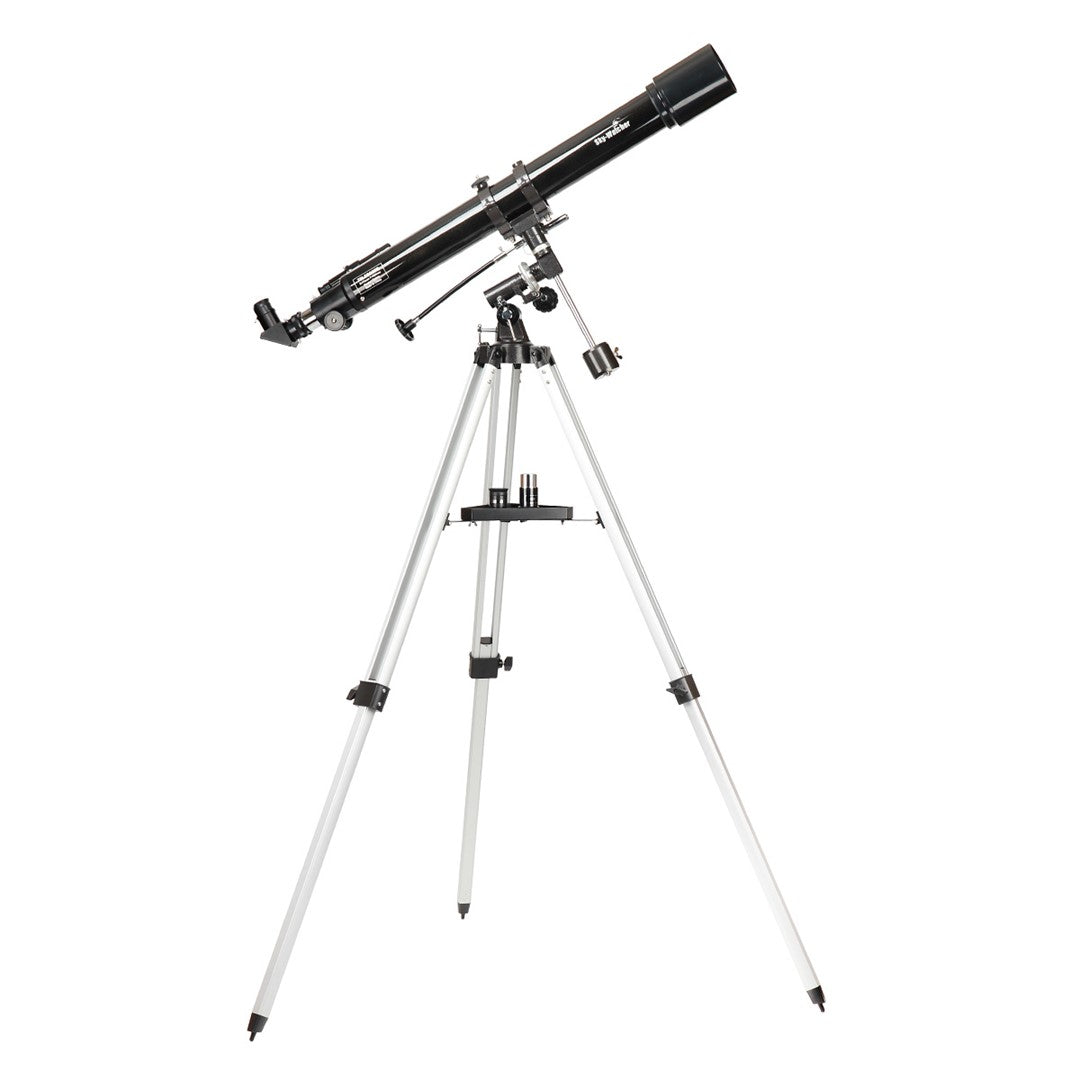
If you dream of studying the night sky and discovering the secrets of the cosmos, the Sky-Watcher BK709EQ1 is the perfect tool for the job. This lightweight refractor telescope with an impressive 70 mm aperture and 900 mm focal length provides excellent viewing capabilities. Equipped with an EQ1 equatorial mount, this telescope is designed for astronomy enthusiasts, both beginners and advanced users.
Accuracy and Precision
The EQ1 equatorial mount is a key component of this telescope. It allows you to track the movement of objects across the sky, which is essential in astronomy. The mount features fine adjustment controls, allowing you to precisely aim the telescope at an object of interest. This means you can observe the sky exactly as you want.
Excellent Optics
The Sky-Watcher BK 709 EQ1 telescope uses an achromatic refractor with a two-element objective lens made of two different types of optical glass. This ensures excellent image quality. The objective lens has a diameter of 70 mm and a focal length of 900 mm, while the f/12.9 focal ratio makes it an ideal tool for observing the Moon, Solar System planets, and sunspots (using an additional solar filter).
High Image Quality
The set also includes 2 Kellner eyepieces with focal lengths of 25 mm and 10 mm, allowing you to adjust the magnification to your needs and see details more clearly.
Eyepiece Drawtube and Observations
The SkyWatcher BK 709 EQ1 telescope is equipped with a standard 1.25" eyepiece drawtube, which provides convenient and precise focusing. Thanks to the 1.25" diagonal mirror adapter, you can be sure that your observations will be even more satisfying.
Explore the Cosmos
With this telescope, you can observe many fascinating celestial objects. Here are a few of them:
The Solar System
- Observe sunspots (with a lens filter)
- Track the phases of Mercury and Venus
- Examine the details of the lunar surface, including mountains, craters, and maria
- During Mars opposition, spot the faint polar cap
- Discover the two belts on Jupiter's disk and the changing positions of the Galilean moons
- Saturn's visible ring and its brightest moon, Titan
- The stars Uranus and Neptune
Stars
- Resolve systems with a separation greater than 2"
- Observe stars with a brightness of no less than 11.8 mag
Deep-Sky Objects
- Examine open clusters from the Messier catalog
- Spot globular clusters as bright patches
- Nebulae visible at low magnification
- Observe galaxies as fuzzy patches
Delivery and payment
Delivery options and costs depend on your country and basket. See them before confirming your order. Tracking is provided after dispatch.
Read the detailsReturns and claims
See our policy for withdrawal and claims. If something is faulty, contact us with your order number.
Read the details