


Sky-Watcher BK 1021 EQ3-2 102/1000 Telescope
Sky-Watcher BK 1021 EQ3-2 102/1000 Telescope
Free delivery
Standard delivery with advance payment. Express and cash on delivery use the regular rates. The final cost is shown before payment.
Delivery detailsOrder cutoff: 13:00 Warsaw time
How we estimate delivery
An estimate for standard delivery, calculated from payment confirmation. Preparation time, weekends and public holidays are taken into account. The cutoff is 13:00 Warsaw time. Final timing depends on the carrier and delivery address. The countdown ends at 13:00 Warsaw time on the next order-processing day. Payment must be confirmed by then. After the deadline, the estimate moves to the next processing day.
Couldn't load pickup availability
Sky-Watcher


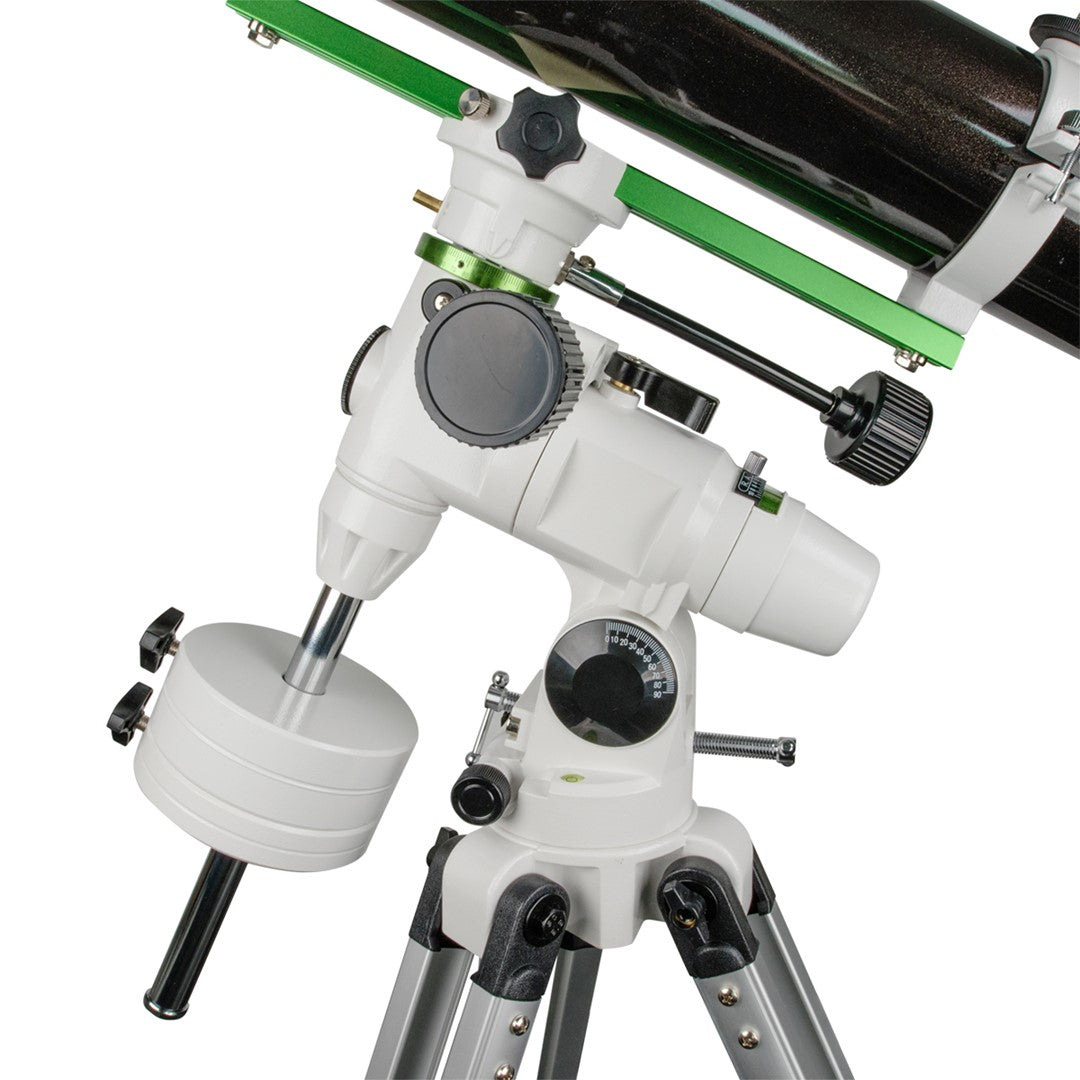
Medium-sized achromatic refractor built around a two-element objective lens with a 102mm diameter and 1000mm focal length. With an f/10 focal ratio and the above specifications, this astronomical instrument offers considerable capabilities and can satisfy even more demanding astronomy enthusiasts. This type of telescope allows for observations of planets and the Moon with fairly good resolution, enables the discovery of numerous star clusters, as well as brighter nebulae and galaxies. The telescope is mounted on a stable EQ3-2 equatorial mount equipped with micro-adjustments. This mount can be considered the smallest suitable for astrophotography. The mount head features mounting holes allowing the connection of any type of drive, including the SynScan GoTo drive.
Optical system
This telescope is a typical achromatic refractor. The 102mm diameter objective lens has a 1000mm focal length. It is built as a classic Fraunhofer doublet and coated with anti-reflective coatings. A 2" diagonal with 1.25" reduction is located in the optical axis. Kellner-design eyepieces with 25mm and 10mm focal lengths are included.
Mount
The telescope tube is mounted on a stable EQ3-2 equatorial mount. It is a relatively massive construction, sufficient for photographing the sky using telescopes up to 150mm in diameter, while at the same time being light enough that the equipment can be considered quite portable. The mount is equipped with precise micro-adjustments; moreover, it is possible to connect fairly advanced drives such as the SynScan GoTo (so-called EQ3-2 Upgrade Kit). The EQ3-2 mount allows for mounting telescopes equipped with a Vixen standard Dovetail mounting rail.
Eyepiece focuser
The BK1021 is equipped with a 2" Rack&Pinion eyepiece focuser (geared focuser). This focuser ends with a mounting ring with clamping screws for 2-inch accessories. A standard Sky-Watcher finderscope mount is located on the focuser body. This focuser is compatible with Sky-Watcher focuser drives.
Astronomical observations
Solar System:
Small features on the surface of the Moon – but no smaller than 1.5 km, caps on Mars, even more details in the bands of Jupiter, numerous comets, brighter asteroids
Stars:
About 1.85 million stars across the entire sky, with brightness up to approximately 12–12.5 magnitude, binary and multiple stars separated from each other by more than 1".
Nebulose objects
Hundreds of star clusters, nebulae and galaxies (with a spiral structure visible in many), many objects from the NGC and IC catalogs. Significant detail in nebulae and star clusters. Spiral arms in galaxies are not visible.
Delivery and payment
Delivery options and costs depend on your country and basket. See them before confirming your order. Tracking is provided after dispatch.
Read the detailsReturns and claims
See our policy for withdrawal and claims. If something is faulty, contact us with your order number.
Read the details